
Just What Does Go on in the Beauty Shop?
I will never forget that great feeling walking to work on the first day. I was back in Rolfe with my children and it was springtime. It was June of 1949. The birds were singing, the flowers were blooming, and I was walking on air. It was a far cry from the previous year in Des Moines. There, all I remember were trucks, busses and sirens. Oh yes, and “Dorothy, my dress needs ironing.”
My first beauty shop, the one I bought over the telephone, was in downtown Rolfe. I don't mean to say I bought an entire office or a building; what I bought was office equipment, consisting of scissors, chairs, hair dryers, combs, some plastic capes and so on. I rented space in the basement of a brick building where upstairs a local physician, Dr. Clark, had his practice.
In fact the first couple of months the shop wasn’t really mine at all. I worked for the previous operator, Aloma, before she got married. This was fine with me since she introduced me to her customers, and on a few occasions, I was glad she was there.
One day after I had been working with Aloma for about a month, I noticed that steam wasn’t coming out the heating pads as I thought they should. Since I wasn’t familiar with that type of pad, I didn’t think much about it. Then I took the pads off and only a little hair was curled. I called Aloma over and she just looked at it. She said she had just purchased this new kind of pad and guessed they weren’t any good. She had me finish the shampoo she was giving and she redid the hair that had not curled. Later, I told her I was sure glad she was there. She just shrugged things like off. I guess we all learn to adapt.
My kids stayed at home alone those first three months when I worked in Aloma’s shop. One day the phone rang and it was Jerry. “You should see what Richard did ?“ he said. I imagined the worst. What did he do? He cut his hair off, of course. I guess it was a case of the son not taking after the old man, but the old woman.
Another time the telephone rang. Again, it was Jerry. You’ll never guess what Melva did. It seemed that a neighbor girl put her finger in an electric socket and got a nasty burn. Nothing serious, mind you. A few years earlier this girl was playing with matches and managed to burn down their cob shed.
One thing that worried me during those first three months when my kids were home alone, was the sound of the fire whistle. I always worried that they might burnt the house down. We had local telephone operators at that time and as soon as I wasn’t busy, I would ring Frances in the telephone office and ask her whose house caught fire. She always answered my ring by saying, “No, Dorothy, it isn’t your house.”
Although the shop in downtown Rolfe was pleasant, I wanted to have my shop in my home. So, a few months later when I received the word that I passed the State Board and could operate my own shop, I moved from the downtown shop to the front room of my house. The room was only 14 x 14 feet, but it was more than adequate. So, now in addition to being able to look after my kids, I didn’t have to pay any rent.
I worried that many of the customers who had been going to the downtown shop for years would not follow me to my own home. But, most of them did and for this I was always grateful.
About that time I started thinking about a name for my new shop. Of course there were the “cutsie” names like The Clip Joint, Hair After, Hair Today - Gone Tomorrow, Cutting Loose, The Cutting Edge, A Cut Above, The Scissor Wizard, Shear Delight, Permanently Yours, and on and on. Then, there were the artiste’ names like Picasso’s Salon Studio, Studio 2000, Studio I Designs, Paris Designs, and so on. For me anyway, I always worried about going into a place where the beauty operator wore what looked like an artist’s frock, where I never knew if I were going to get my hair cut or painted.
Then, of course, there are the “homey” names like Donna’s Designs, Nancy Cut & Curl, Barb’s Boutique, and so on. I opted for this type and named my shop, Dorothy’s Beauty Shop. Later, I decided to go “high brow” and called it Dorothy’s Beauty Shoppe.”
When I started work in my shop, beauty operators were required to wear white cotton uniforms that had to be starched and ironed. A few years later, nylon came along -- such a help. Still later, we were allowed to wear colored skirts with a white tunic. Although clothing requirements changed, we were always required to wear white shoes.
After moving the shop into my home, things really started to look up. Without having any rent to pay, I managed to save some money and in only a couple of years managed to get out of debt. I can still remember writing that last check.
I was so happy getting out of debt that I decided to redecorate my shop, the 14 x 14-foot room in the front of my house. The shop furniture was never new and the room was not remodeled when I moved into my home. So, I bought some new equipment, put in a new floor, and painted and papered the walls. Three walls were painted a pale green and the fourth one was covered with an eye-catching wallpaper of birds and green vines. You almost thought you were sitting in an bird cage. I thought it gave my shop a nice touch.
I asked one lady, known for her brutal honesty, how she liked the new decor. She said, “It’s all right if you like green.” Then added, “But who likes green?“
But I liked green and those birds kept me company for many years. For the next twenty years I had some of the most enjoyable experiences of my entire life. My customers became my friends. I loved them all and I like to think the feeling was mutual.
Pediculus humanus
When you go to beauty school you learn a lot more than just combing hair and giving permanents. We learned the Latin names of every muscle and nerve above the waistline. We never learned why we had to learn the Latin names of every muscle and nerve above the waistline -- we just did. I guess if someone came in your shop and told you she wanted you to trim her Dermis carposus, you’d know right away what to do.
Oh yes, another thing we learned about in beauty school was about Pediculus humanus. You know, head lice. Of course, our teacher told us the only critter we would ever see would be the one in the textbook. But, for completeness, there it was. So much for Pediculus humanus.
One day a smartly dressed lady comes into the shop complaining of scalp itch. She had just gotten out of the hospital and had developed this persistent itch. She had stopped by the doctor’s office before coming to my shop to determine the cause. She said she didn’t want to come to my office if she had something contagious.
But she told me not to worry since ‘Doc’ took a peek at her head and told her the itch was probably just a side effect from the medication she’d been taking. She then proceeded to sit down and I put a cape around her neck. I then took a comb out of the drawer and ran it through her glomp ! The comb came to an abrupt halt about a half inch into the hair. Good grief, I wondered. What do we have here? My mind then flashed back to that textbook picture from beauty school.
Pediculus humanus? “Excuse me,” I said and carefully removed the comb from her hair and walked to the other side of the room where I put it in a pan of formaldehyde solution. Were my suspicions correct? I knew “sticky” hair was not a good sign. I had to be sure. You don’t joke about lice. You don’t just say out of the blue, “I wonder if you’ve got lice?“ I walked back and carefully pulled the hair apart. The textbook Pediculus humanus would not be the only head lice I would ever see. This little guy tried crawling under some hair where he could be safe. It was probably a she rather than a he since her hair was full of nits. Dirty sticky nits.
I gingerly removed the cape from around her neck and took a rather deep breath. Ok, I said to myself. Say it, Dorothy. Say it out loud. It isn’t a sin to have lice. Anyone can get ‘em. What was I going to tell her -- you’ve got lice? No, Dorothy, you’ve got to be more tactful than that.
“You’ve got lice,” I said. “It’s not a sin to get lice,” I added hurriedly. “Anyone can get ‘em.” The woman sat in the chair horrified, and then she said at last, “I asked my husband if there was a chance I might have, uh …
“Don’t be ridiculous,” her husband said, “No one gets ... uh,..“
But ridiculous or not, she had ‘em. I told her how to get rid of them and added that she might give her husband the same treatment. I then sent her home with a cheery, “See ya later”.
I then made up some excuse and canceled all my appointments for the day and spent it washing down the shop with formaldehyde. I hung that cape on the clothes line for the next week. After that I burned it. You can never be too careful with Pediculus humanus.
A few weeks later I was in the grocery store and happened to meet her. She thanked and thanked me over and over for discovering the source of her itch and how to get rid of them. I never told a soul about the lice, not even my children, for all the obvious reasons. I suspect that she might have been thanking me for that, too.
Hair dryers are not as new as you might think. As long ago as 1500 B.C., hot irons were used by Assyrian slaves to curl the hair of kings and queens. In the 1920s the idea of blow drying a woman’s hair started as an advertising gimmick for a vacuum cleaner that proclaimed you could “even dry your hair with it.” By attaching a hose to the exhaust one could easily dry hair. (A little dusty maybe, but dry.) A company in Wisconsin that had just invented the electric milk shake mixer used the motor in the mixer to make the first commercial blow dryers.
When I was in beauty school, they told us we were learning to become Cosmetologists. For someone that was one for twenty years, that was about the last time I ever heard that word. Most people would say that a person who cares and beautifies hair is a “beauty operator” or “beautician.” Other common names are hair designer or hairdresser. Most beauticians don’t care what you call them, just don’t call them barbers.
From time to time beauty supply companies would hold seminars over the weekends in various places. At that time they would demonstrate such things as how to use their new products or how to give new haircuts and permanents that were becoming popular. Anyway, at one of these lectures we were told that we were not beauty operators. That sounds so unprofessional, the man said. You are professionals. You are beauticians and you are hair dressers, but you are not beauty operators. I guess we had an identity crisis.
Giving the Customer What They Want
In the early 1950s most girls wore their hair
fairly long. I had a customer who had a 16-year-old daughter who had beautiful
long hair. The hair was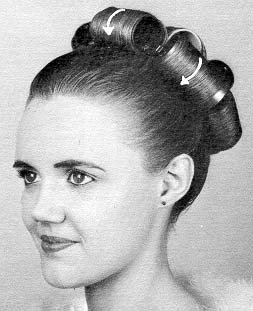 naturally wavy and it bounced when she walked. The
mother was so proud of that hair. But, then it happened. The duck tail!
Every girl in the country was getting one. Especially the girls that had
naturally wavy hair. It was so cute. And so short. The duck tail turned up in
the back just like a duck’s tail. Very short. The daughter wanted to get one,
too; all her friends had one. No dear, you have such lovely bouncy hair. But
Mom, my friends… Now that is enough of that dear. Some day you’ll thank me.
naturally wavy and it bounced when she walked. The
mother was so proud of that hair. But, then it happened. The duck tail!
Every girl in the country was getting one. Especially the girls that had
naturally wavy hair. It was so cute. And so short. The duck tail turned up in
the back just like a duck’s tail. Very short. The daughter wanted to get one,
too; all her friends had one. No dear, you have such lovely bouncy hair. But
Mom, my friends… Now that is enough of that dear. Some day you’ll thank me.
A few days later the telephone rang. It was Mother. I could almost hear the tears coming down her face. Daughter had gone into the bathroom. Locked the door. Well, ... I don’t have to tell you what she did. I just don’t know whatever possessed her, the mother said. What can you do, Dorothy? she asked. I didn’t want to tell her I was a beauty operator, not a magician, but I told her to bring the daughter to my shop and I would take a look at it. Oh my. Oh my.
Later that day they both came in. Daughter had chopped it up pretty good, but I did the best I could with such short hair. A duck tail, of course. It was the only cut I could give hair that short. Daughter was in seventh heaven. Mother did admit that it did look kinda cute. They left. Daughter smiling broadly. Mother shaking her head, saying to me as she left, “I don’t know whatever possessed her. Children!
What Do They Call Ten Rabbits Walking Backwards? A Receding Hairline, Silly
Young girls go to beauty school because, “I just love working with hair -- those new styles are so groovy. [At least they used to say that.] I’ll go back home and introduce the new styles to those old women who haven’t changed their hair styles in fifty years -- I’ll make the town over.” And then they arrive back home to the real world and ... .
Much of my income was earned from older women who developed arthritis in their arms and had difficulty lifting (oh, so stiff, they’d say) their arms over their heads. Many of these women had worn the same style since they were girls a half century before. That was the style they wanted. You had better believe it, too.
The word “shampoo” was originated in England by British hairdressers from the Hindu word “champo,” which means “to massage.” But it wasn’t until 1890 that the first detergent-based shampoo was introduced in Germany. Before this time women washed their hair in various concoctions, such as Egyptian women who washed their hair in a mixture of water and citrus juice. The modern shampoo business owes its start to the American, John Breck, who developed various scalp cleansing solutions in an attempt to stop his own baldness. He didn’t succeed in curing his baldness, but he did come up with a shampoo that became popular in beauty parlors back in the 1930s. Nowadays, shampoos do a lot more than just clean hair. They prepare your hair for perms and hair coloring, as well as add body, texture and shine.
I had an elderly customer who had beautiful white hair. She wore it finger waved (this was popular a long time ago) straight back so that her forehead would show. A forehead that showed her intelligence. But then it happened. It’s called aging. Her white silky hair started to recede at the temples. “Can’t let her look bald,” I thought. So each week I’d swing the wave over to cover the bald spot and put a little curl over the thin spot on the other side. Hardly noticeable. Don’t mention it to her. She always seemed so pleased. Then one day about a year later she said, “You’re not putting my wave straight back, Dorothy.”
Uh, I hesitated and explained why I was doing what I did.
“I don’t want it that way. Put it back like it was – straight back!” I did. The next time I started the slow process over again. Didn’t want her to look bald.
And she wasn’t the only old lady who had her own ideas about hair styles. One lady in her eighties had never cut her hair in her entire life. Never! But each time she came in the shop she told me she was thinking the impossible. After all, it was the mid 1950s and short hair was the rage. I kept telling her she should think about it more before taking the big jump. I knew she would be unhappy after it was cut. Then one day she said she decided against cutting her hair. “Last night,” she said, “I had a dream that you cut my hair and I looked terrible. When I awoke I realized it was still there. My long lovely hair. You’ll never know how relieved I was,” she said I was a little relieved, too.
I had another elderly lady whose long hair hung to her waist. I always cut and curled the top and sides, but she left the back long. The first time I gave her a perm, I wondered what I was going to do with all that hair. She said she wore it in a “figure eight.” Uh, well they hadn’t taught us how to make those in beauty school. I had no idea how to make one Well, I held my breath and took that long hair and made a figure eight. Or at least it looked like a figure eight to me. However, the next time she came in she asked me if she might do the “figure eight” herself. I was delighted.
It was an education to watch her. She leaned forward from the waist with all that long hair hanging in front of her. She then swung that long hair around as you might swing a lasso and started to pin it up. I thought it would be a mess, but when she was finished It looked lovely. All that long hair was done up in a large bun that really looked like a figure eight. Yes, it was shaped like a number eight. No doubt every pin was put in the same place it had been put for the past 70 years.
Her family hosted an open house for her birthday. It was her 95th, I believe. I had just given her a perm the day before, and she was worried that it would not look real nice for her party. I told her to have her daughter-in-law bring her in after church and I would comb it for her. This she did and after her hair was all combed and in place, I took a fancy comb out of my showcase and put it beside her perfect figure eight. She was thrilled with the comb and insisted she pay for it, but I couldn’t let her. After all, it isn’t every day that one has the privilege of giving a small gift to a 95 year-young lady.
When I worked on her, she often told me about her younger days and about the good times she had when her future husband was courting her. I discovered that kids back then had the same interests and as much fun as they do today.
This dear lady lived nearly a century. I had the privilege of fixing her hair after she died. Yes, I thought of it as a privilege. After I combed out the top and sides, the funeral director asked me what I was going to do with all that long hair in the back. I told him, “ I’m going to do it in a figure eight, of course.”
You Did Say Pinkish Rinse, Didn’t You?
My father used to say if you give my Mother a paintbrush, she will paint everything in sight. For other women, give them a bottle of hair dye and they will color every head of hair in sight.
“Well Dorothy, you know I like to do different things with my hair, one of my younger patrons told me once. “I’ve been blond, I’ve been brown, but I’ve never been this pinkish color before. And she decided she didn’t like the latter. She had just come home from college but before she left school, she had gone to a drugstore and bought some hair coloring. But, whatever color she had intended, it didn’t come out as planned. So she came home and I managed to get the color back to her original light ash blond. I think she kept it
Candy, a teenager, had lovely hair. Her mother always wanted it curled, but somehow it never seemed to curl very well. When the shorter style came in I suggested that we cut it short. It was absolutely lovely. I told her mother that with Candy’s high cheekbones she looked like a cute papoose. Her mother laughed and told me that she had Indian blood on both sides of her family. Indian hair needs to handled differently than the hair of whites.
African woman have always regarded their hair as a reflection of their heritage, and have decorated it to reflect family and tribal customs. Because African-American hair is generally curlier and courser than Caucasian hair, various hair products have been developed over the years to address this fact.
One person in particular, Madame C. J. Walker, is credited with starting the modern black care revolution. The orphaned daughter of ex-slaves, she created a multi-million dollar industry in the health care industry from a single ointment she cooked up on her stove in 1905.
Even though people travel far and wide, they often return home from time to time. This one young woman left Rolfe to live in the southwest part of the United States, but came back every summer to visit her parents. While in town she would come into the shop and I would shampoo and set her hair. She was a delightful person and we were good friends. Well, she had just arrived for her annual visit and came into the shop. But this time there was something different; she had a towel wrapped around her head. She asked me if I had time to do something with her hair. It seemed she hadn’t had time to go to her regular beauty operator to get her hair colored before she left home, so her husband told her he’d help her out. She was going to put a little ash-brown coloring in her hair so it would match her complexion.
I asked her what she wanted me to do, thinking she probably wanted a set. Well no, I need a little more that, she said. I told her to take off the towel so I could take a look.
She did. She had the brightest orange hair I had ever seen. I couldn’t help but laugh and neither could she. It was the funniest head of hair either of us had ever seen.
She told me that her husband offered to go to the drugstore for the coloring. He looked over all the colors and discovered that ‘warm’ coloring meant more red. It just adds some tint, the druggist told him.
Her husband even offered to help color her hair when he returned home. This is the kind of husband every woman should have. Yeah. When he finished the job, however, her hair didn’t have just a tint of red, but was a very dark red. The husband told her it wasn’t his fault, but that of the druggist. Her husband told her not to worry, however, since the box said if the color turned out too red or too dark, just shampoo and it will come right out. Yeah.
So they shampooed, and they shampooed, and they shampooed. “And you know what,” she said. “It was still dark red!” But my husband told me not to worry since we could always use some peroxide on it. But, they didn’t have any peroxide, so he suggested laundry bleach. It was the same stuff, he told her. After all, if laundry stains come out, so will the dye. This is the kind of husband every woman should have. Yeah. Well, they used the bleach and just as her husband said, the red came right out. It was now orange. At that point the husband didn’t have any more suggestions.
So, for the next hour I took out the remaining coloring and dyed it back an ash brown. We laughed the whole time. I suspect she remembers that incident to this day. And I suspect she reminds her husband about it, too.
While blonds may not really have more fun than brunettes or redheads, they certainly spend more time in the beauty shop getting it that way. Blond hair has been the “hair of choice” for most women since the days of Greece when women used bleach from Phoenicia to lighten their hair. In the 4th Century B.C., the Greeks said that the sun’s rays were the best way to lighten hair. During the first-century the Romans preferred black hair and dyed it with a mixture made by boiling walnuts. In England during the time of Elizabeth I, red-orange hair was popular. Although the first commercial haircolor was made in France in 1909, it was the American company, Clairol, that launched the modern day business of hair coloring with its ad, “Does she or doesn’t she ?“ She does.
And as a matter of fact, so does he.
When I was in beauty school I was in my early 30’s and was beginning to show a few white hairs in the front. The other girls always said they liked to set my hair so that the white showed up. Soon a great deal of white was showing. One time when my son, Jerry, came home from college he looked at me and said without batting an eye, “You’d better do something about that”. Well, I followed his advice. I left some white in the front, but the rest remained a pretty dark brown (right out of a bottle) for all the years I worked -- and some years after that.
In fact one day one of my younger customers asked me how I got that white hair so white, and natural looking. I just smiled, and told her that was my natural hair color, but the nice brown came out of a bottle. You’re kidding, she said. No I wasn’t kidding.
So, what’s the best way to stop falling hair you ask? That’s easy, the floor! Actually, I am trying to make a point. Sometimes people would come into my shop and expect the impossible. Sometimes I could help them and sometimes I couldn’t.
One day two high school girls, who had parts in the Junior Class Play, noticed that the playbook said one of their characters was supposed to have dark brown hair, but the girl had light brown hair. So, what to do about it. It was obvious something had to be done.
So, they went to the drugstore and bought some dark brown hair coloring. They did. And they colored her hair. They did. And did it come out a nice dark brown? It did not. But it did come out the loveliest dark green you could ever imagine. If she had played a frog, she would have loved it.
And guess where those two young girls went next after they saw the green hair? You guessed it. The next morning this girl and her friend knocked at my door at 8 A.M. Unfortunately, I had to tell them I was busy all morning, but to come back over the noon hour and I would try to do something for them. They then went to school. When the director of the play saw the leading lady with dark green hair, I understand she nearly fainted.
But over the lunch hour I worked on her hair and by I P.M., it was back to the original medium brown. I don’t think she tried making it dark brown again though.
If there is one thing that will make a beauty operator grimace, it is the lady that comes into the shop with photo of a beautiful model and say, “This is how I want my hair.” Especially, if the model is a young, beautiful woman with great hair and a fabulous face and the lady in your shop is, uh, not a beautiful woman with great hair and a fabulous face. You generally say something like, “But, it wouldn’t look as good on you since she has such a skinny body and you are a little, uh, more rounded.” Of course, you never actually say that, you just think it. Just keep a smile on our face and start making suggestions.
It began like any normal day. I had just finished shampooing the first lady and put her under the dryer, and was starting to shampoo the second lady. I was using my new shampoo hose with its high pressure nozzle. The older one was too heavy and didn’t have enough pressure. I liked a lot of pressure to get the shampoo out of the hair.
So, I lathered up her hair with shampoo and after washing it, reached for the nozzle. I wanted to test my new nozzle so I turned on the water full blast. Do you know what happened? I guess I had shampoo on my hands and that nozzle took on a life all its own. It shot out of my hand like a rocket and stood almost straight out. It whirled around and around in the air and sprayed water to every corner of the room. It didn’t miss a spot including the lady under the dryer. I finally managed to grab the thing and turn off the water. The poor lady under the dryer must have jumped a foot. The lady getting the shampoo didn’t move a muscle.
George the Resident Cat
For many years while I worked in the shop I had a big black cat named George. At the time it was the state law that pets were not allowed in beauty shops. Now, although George generally didn’t obey many laws, he did obey this one. He never did come into the shop; he’d just walk by the door and stop and look inside. Well, I shouldn’t say never. There was this one woman, who if she were under the dryer, he would always stop and look, and then come in and try to jump on her lap. I always managed to intercept him, however, before he did and put him outside. This lady was never aware of the attraction she had on George. I asked her once if she liked cats. She looked at me and said, “I can’t stand them.” I started to think that George might have had other ideas when he came in the shop.
I Don’t Do Doggie Cuts
One very hot day a lady came into my shop carrying a small white poodle. It was the cutest little poodle you ever wanted to see. The way she made over him, I thought she wanted his hair cut. But she didn’t and she just put the dog on the floor and tied its lease to the chair. I joked and said not to get upset if I suddenly grabbed the dog and threw it out the door, it only meant the state health inspector had just driven up. She offered to take the dog outside, but I said it was O.K. for him to stay. After that, however, she took my hint and tied him to a tree outside. I always wondered how George treated that dog when he was tied up to the tree.
Pregnant Ladies and Babies
Pregnant women often go to the beauty shop and mine was no exception. States have many rules that all beauty shops must follow, and requiring each shop to have a berthing room might not be a bad idea. And a two-way radio connected with the nearest hospital.
One day a young mother-to-be came into the shop for a hair cut. Very pregnant. She had long brown hair. Very thick. Cut it off, she said. Cut it short. I won’t have time to bother with it after the baby is born. I started cutting. Beautiful hair. Wavy, bouncy. Almost a shame to cut it. I barely took a couple of snips off the back when her head dropped forward. Thinking she was just a bit tired, I used my usual “head raising technique” for drooping heads and pushed up on the chin. But her chin didn’t lift. I looked at her cheek and it was very white. She had fainted. Passed out cold.
Call to the lady who had just come in. Come help. I quickly removed her cape. Grab her under the knees and I’ll hold her under the arms. Lay her on the floor. Rub her arms and legs. I’ll get a wet towel and rub her forehead. Hurry. Hurry. Just keep calm.
She comes to and starts to sit up. Stay laying down we tell her. I’m sick, she says. Quick, the basket from under the shampoo bowl and dump out the empty perm bottles. Hurry so she can use it. She is sick. Vomits. She gets up and sits in a chair. Still weak and woozy.
Her husband then arrives to take her home. I escort her to the car, and tell the husband what has happened. Tell them to come back later when she’s feeling well and I will finish cutting her hair. Walk back into the shop.
During the entire incident there was a third lady in the shop who was under the dryer absorbed in a magazine. When I came back in the shop she stuck her head out from under the dryer and asked me what was going on? I look up and you had this girl on the floor,” she said. “What was she doing down there?” Another day in the beauty shop, I thought.
Kids. Kids, and Kids
For the most part I loved working on little girls. Well, most of them anyway. One of my customers had a four-year-ponytail old daughter she always brought with her when she came to my shop. She was such a darling little thing and seemed to have a special liking for me. She also had a special liking for Tootsie Rolls. I always gave her one when she came through the door. No doubt the Tootsie Rolls played a crucial part in our friendship. But, she was my good friend. So I thought. Her mother had been telling her for weeks how nice it would be when she got her very first haircut. And with a big smile that stretched from ear to ear, the little girl told me she was going to have her hair cut someday. She would sit in that chair and let me cut off those curly locks. That’s what she told me. Someday came. Her very first haircut. In they came. All smiles. I put the little board across the arms of the chair and suggested that the little one jump right up. Little little girls give beauty operators who plan on cutting off their locks. She put her hands on her hips and planted her feet apart and announced, “You’re not going to cut my hair.” Mother begged. Then she threatened. Then she did everything she could think of. Daughter did not cry, but she did not get into the chair. She did not have her hair cut.
This whole scene was rerun many more times at later dates. Every time she would come through the door beaming. But when the moment of truth arrived, she became as stubborn as a mule.
Then one day the little girl came beaming in the door, but this time her mother wasn’t with her. Her father brought her. When the little girl went through the her usual routine, daddy picked her up, sat her in the chair and said, “Now sit!” She did, and I cut her hair. I cut her hair many times after that. I wonder if she still likes Tootsie Rolls.
One of my customers had a teenage daughter who had long brown hair, but the mother decided she wanted the daughter to get her hair cut. So, they both came in and the girl got in the chair. This was in the 1950s when hair was very short. So, I parted off the lower section of hair and pinned the rest to the top of her head. Took my scissors out and cut off the lower section to the right length. Everything was going fine. Oh, yeah. Just then Daughter started to cry. What is the matter dear? Mothers use a certain tone of voice in a beauty shop when talking to their daughters. Yes, they do. They sometimes have a certain tone of voice when they talk to the beautician.
Mamma, I don’t want my hair cut. At school the girl would have said, mother, but in the beauty shop it was always “mamma.” But you said you wanted your hair cut, Mother said. No I don’t, said the girl, her voice rising to a pitch that would break a glass.
But my dear, me speaking, I have already started to cut it. It won’t look very good if I leave it like this. But I don’t want it cut. Louder and louder. I don’t want it cut. Mother then said limply, Well if you really don’t want it cut, I suppose you don’t have to have it cut. But I’ve already started. It will look terrible. Me speaking again. I felt like crying myself. So I didn’t cut any more and the girl was happy. I wasn’t.
It reminded me of the time I told one mother to let her daughter and myself decide how to cut the girl’s hair. The two of them had spent an hour haggling over the length of the girl’s haircut. I was tired and it had been a long day. Sometimes thoughts become words when they shouldn’t and I said something like, “Well, I wish you would make up your minds.”. I smiled and started “treading water”. “I’m sorry, I didn’t mean anything by that,” I said. We remained friends. The girl got her way and I cut her hair and gave her the perm. Everyone was happy.
One day a woman came in with her little girl, a third grader, who had never had her hair cut and was more than just a little shaggy. So, I cut the girl’s hair and gave her a perm. Anyway, a few weeks later this little girl’s teacher comes into the shop. She told me she came to school one day and saw a new little girl in the class. She thought it was a bit odd that the girl’s mother wasn’t with her on her first day, so she went back and asked the new girl her name. The girl looked up with her usual sweet smile and told her. Did she feel embarrassed, she said. The girl really did look different.
Little girls often have ideas about hair, too. One time a little miss, a ten year old, came into my shop. Her mother made the appointment for her just before school was to resume in the fall. I wasn’t exactly sure what kind of cut the mother wanted, so I asked the girl. Oh just trim it a little, she said. Are you sure that’s what your mother said. Yes, sure! I did. I trimmed her locks just a little. She skipped happily out the door and headed home. Ten minutes later the telephone rang. You guessed it. Mother, on the line said, “Why didn’t you cut my daughter’s hair?” Guessing what was going on I told her what my instructions had been. “Oh that child,” she said. I suggested the daughter come in again and I would cut some more off. She did. The mother was happy. I’m not so sure about the girl.
One lady in town had three of the best behaved children you can ever imagined and were my very favorite customers. When she came in for a haircut, she’d sit the little ones on the floor and give each of them a book, where they would sit and read while I worked on their mother. Once she brought all three of them in for haircuts. She explained to the girls that she had to go downtown but that she would be back soon. Now, the two older ones had been in for haircuts before, but the little one hadn’t. I cut the two older ones and then sat the little one, who was about three, upon the board and cut her hair. She was so good but when I lifted her down I noticed that her panties were a little wet. She must have been so frightened. She was a perfect dear. I gave her a special hug along with a special treat. She came in for many more haircuts, and we became very good friends.
The husband of one of my regulars suggested that I put my shop on his front porch. After all, he said he supported me. His wife, daughter, mother-in-law, and even some sisters-in-law were all regulars of mine. He said it would be nice to hear what was said in that shop. If he only knew.
Over the years I’ve heard more than my share of comments from husbands who sometimes accompany their wives. Here are a few things I’ve heard from husbands who have come in the shop.
“Don’t cut my wife’s hair. It looks sexy the way it is.”
“Why don’t you do something different with my wife’s hair.”
“Hello, I’m the better half of ....
(if he is bald) “Can I get a permanent?”
Some things require a sense of humor -- otherwise you might get very irritated. There is always the mother (always the mother) who makes an appointment for her darling daughter and tells you how she wants (the mother wants) the hair cut. This is fine but unfortunately, it never ends there. While you cut the little darling’s hair, these mothers stand next to you and tell you how to cut every single snippet of hair, which, of course, is not a very good way to give a good haircut) You get nervous and can’t make a move without bumping into the mother. I once asked a good friend of mine and a beauty operator if she ever had this problem. “I’d like to step back and come down on her foot with a pair of high heels,” she said. I guess I wasn’t the only operator who had this problem.
My Kids in the Shop
One rule I made when I started to work was that my children could come into the shop and stay as long but they had to be quiet and not be rowdy while in there. I never had to scold them at any time so I pretty good.
I also told them that I hoped they would smile and speak any of the customers. They must have done this, for it wasn’t long until my ladies started telling me that I had the most friendly children in town.
Barb used to come in and visit with the ladies or read a book sometimes. One of my ladies always brought me flowers from her flower garden and one day as Barb, who had allergies, came into the shop. She stopped cold and said, “Where is it”? I knew what she meant, and pointed to the flower. My lady never brought another one in.
Jerry never spent much time in the shop. He would stop and tell me he was going over to see his friends, but that was the extent of his visiting.
Since Richard was only four years old when I started working, it was quite different for him. He practically grew up in there. He would bring his ‘Little Golden’ books in and lay flat on his stomach in the middle of the floor and read them. Several of my ladies would have him sit on their laps and read to him while they sat under the dryer. I suggested that he lay to one side of the room, but sometimes he would forget and lay in the middle, so that the ladies had to step over him.
Mrs. P. came to my shop every Saturday afternoon at four o’clock for the entire 20 years that I worked. It was not uncommon for her to bring me an ice cream cone or some sweet rolls that she had baked that morning. I have never eaten rolls as light and fluffy as hers. She also brought Richard a package of gum every week. One day I told her maybe she shouldn’t since she would spoil him. “Now you keep quiet,” she said. “This is between Richard and myself’. After a while I told Richard he really shouldn’t expect a treat, but he always camped out by the door when she arrived and gave her a big smile. Later, he even started meeting her at her car to turn on the charm.
Little Boys and Puppie Dog Tails
Sometimes I think all the equipment you will ever need when working on little boys is
one plastic cape
one safety pin
one standard comb
one pair of good scissors
one Colt 45
Now I hope you don’t’ think I’d ever think about shooting one of those little fellas, but there have been good times …
I generally worked in the shop from Tuesday through Saturday, and took Mondays off to do housework. Well, one Monday when I was doing my laundry, a lady knocked on the shop door and told me in no uncertain terms she wanted me to cut her son’s hair. Now. Son was about eighteen months old and quite a husky child. Well, I don’t know why, but I agreed. So, I placed the little fella in my special high chair, and, Waaaaaaaaaaaaa. Cried. Yeeeeooooooooo. Screamed. Stiffened up.
But the mother was determined. She sat in the chair, held him on her lap, and put a death grip on the kid. She was a large woman, and said, “Now cut it.” I was somewhat skeptical about cutting under such circumstances and started giving her all kinds of excuses why it might be a good idea to wait until a later date. About ten years, I was thinking. It didn’t work. She wanted it cut, NOW.
So, she held the kid, and I put the cape around his neck. He pulled it off. I put it back on. He pulled it off. The mother said to leave it off and just start cuttin’. I did. He screamed. I cut. He was so hot from squirming that he was soaking wet in sweat. There was sticky hair all over the kid, the mother; and me. It was nice to have a day off now and then.
One customer, who was also a close friend, became pregnant and told me she wanted me to give her new baby its first haircut when he or she arrived. Well, anyway it was a he, and about a month later she came in the shop carrying her new arrival. “I came in so you could give him his very first hair cut,” she said. I laughed. Then she said she was serious. “What hair ?“ I asked looking at him. She then laid him across her lap and said, “That one.” There on back of his little neck was a single strand of hair about an inch long. So, I took my scissors and ... snip. She took the hair to put in his baby book. He was the youngest customer I ever worked on. And no, I didn’t charge her a penny.
A few years ago, a long time after leaving my shop, I happened to meet a young lady while visiting a friend. In our conversation she just happened to mention that she attended grade school in Rolfe. She told me her maiden name, and I started thinking that I knew her when she was a child. I told her I was the beauty operator in the shop across the street from the school. “You cut off my braids,” she said. Yes, and you cried and cried, I said. Yes I did, she said. Yes I did.
Since the early 1900s, the permanent (perm) wave has evolved from 18 hours of torture with unpredictable results to a relaxing 60-minute procedure.
Throughout history women have valued the curls in their hair for status, religious significance, political messages, and beauty. Woman have endured more than just a little discomfort to obtain curls in their hair. The ancient Egyptians heated irons to curl royal wigs, and the Greeks used rollers to curl hair. But, it was not until the mid-1980s that a Frenchman named Francois Marcel became famous for his hair waving. Later in 1905, an Englishman named Charles Nestle created the first permanent wave machine that involved winding the hair around a rod and coating it with an alkaline paste enclosed in hot clamps. Electricity was used to heat the clamps until the hair had been sufficiently cooked. The entire process took six hours and the clients got plenty of curl. They often got dry, frizzy hair that was often damaged.
The story is told that Marcel began his career currying horses, but then decided to become a hairdresser. He failed at hairdressing so he returned to the horses. But, one day he noticed that a lock of his mother’s naturally curly hair was hanging straight and limp. He tried to restore the curl with an iron, and behold, he got a natural- looking wave.
In the early part of the century, there were very few beauty shops, and it was almost a sin to go to a beauty operator to get your hair done. One of my instructors in beauty school said women would often sneak in the back doors of beauty shops. Occasionally, a lady might get a Marcel wave. It was the real thing back then. I remember when my two older sisters, Pauline and Helen, got Marcel waves for their weddings in the 1920s.
As a young child I wore my hair in a Buster Brown cut. This style had short bangs over the forehead and was cut straight around the sides just above the lobes of the ears. Another style popular with girls and one that didn’t take the attention of a beauty operator was long straight hair. Older ladies pulled their hair back into a bun at the nape of their neck or on top of their head.
In Iowa the permanent wave or “machine wave” (the one invented by Charles Nestle) came into vogue around 1930. The first one I ever saw was demonstrated at the County Fair in Emmetsburg when I was a teenager. I remember the man who demonstrated the process saying it was the best thing that ever happened to women. And, insofar as women’s hair was concerned, he was probably right. The first permanent waves were given by wetting the hair with a waving solution and wrapping it around metal rods. The rods were then enclosed in hot clamps causing the waving solution to penetrate the hair shaft and curl the hair. The clamps were heated with electricity with the net effect that the women getting perms would sit under a maze of circuitry with steam hissing out of their hair. It looked like any moment she might either be electrocuted or boiled alive.
I gave a few of these “machine waves” when I first started working in 1949, but they were soon a thing of the past. While the steam was hissing from the woman’s hair, I had to stand next to her with a blower cooling down the “hot spots.”
“It’s getting hot over here, Dorothy” I can still hear the ladies saying. We were told in school not to ask if it was too hot, but was it comfortable. Believe me, it wasn’t comfortable, it was hot. As I have learned many times over, ladies will do almost anything for curly hair.
Thankfully, by the time I started working in 1949 a hair treatment called the “machineless wave” (also, called the heat wave) replaced the machine wave. In the machine-less permanent, the lady didn’t have to worry about getting electrocuted. Small pads filled with chemical compounds were wet and wrapped around the wet hair causing the hair to curl from a chemical reaction. When the chemicals in the pad became wet, they became hot and steamed. The pads hissed and steamed, but it wasn’t as hot as the machine wave.
One day I was was about to screaming that giving a machine-less clamp on the pads they were too hot. Well, wave to a lady and when she started I knew they weren’t too hot since I hadn’t wet them yet. I told her so but she kept on screaming. Finally, I took her hand and placed it on her head. When she felt the cold rollers, she calmed down. Women always worried about those pads getting hot.
Today’s hair products are a far cry from the way they were in 1500 B.C. when the Assyrians first began styling hair. Later, the Greeks thought that good hair style denoted culture and distinguished them from the “barbarians” of northern Europe.
About the time I started working in my shop, the large hair products companies (like Helena Rubenstein, Toni and so on) started selling the “dreaded” home permanent put out by the Toni company, called the “Toni.” it caused a great deal of concern among myself included. But, although many themselves home permanents, it didn’t very much. I guess the old adage if a woman has a dollar to spend, a beauty operator will never starve, remains true.
More on Hair Styles
Since the beginning of time a woman’s hair has
been her crowning glory. It is the fascination with hair that gives women the
delight to arrange her hair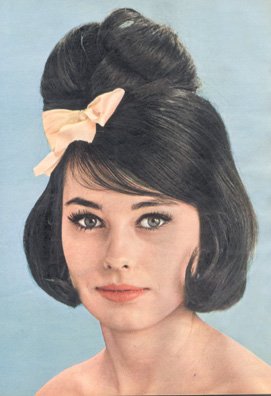 in an unusual and beautiful way. And it has always
been that way. In the Song of Solomon it is written:
in an unusual and beautiful way. And it has always
been that way. In the Song of Solomon it is written:
How beautiful you are, how very beautiful.
Your eyes are doves behind your veil.
Your hair is like a flock of goats,
Moving down the slopes of Gilead.
In the New Testament it says that if a woman has long hair, it is her glory. And how down through the ages women have loved doing things to their hair.
In the 1920s women started doing the unheard of thing of cutting their hair. And men, especially, thought for a woman to cut her hair was sinful.
I remember as a girl in the 1920s many young ladies were cutting their hair. Spit curls, as they were commonly called, were in vogue. A little lock of hair was curled flat on the forehead, in the shape of a number six, probably using spit to make it lay. Thus the common name for it. This was in the time of the Charleston and the Clara Bow days.
Ladies started wearing Marcel cuts. You could purchase a Marcel iron or a plain curling iron and if you could heat them to the right temperature, you could make nice little weenie curls.
When I started working in 1949, a three-inch cut was considered short. The heat waves had been popular for many years, and now the cold wave was coming in strong. You could give a cold wave in very short hair, where as to give a heat wave the hair had to be left longer.
Only the older ladies still wanted the plain finger waves. The younger ones were using pin curls to set their new permanents. These could be combed out in a nice soft wave or combed into a nice curl, depending on what you wanted. The pompadour was the most popular style at this time. The top was combed back into a deep wave, while the sides were combed up and back in a sleek wave.
Those who wanted their hair left long usually wore the back tucked up in a snood. This was a pretty net with ribbons or flowers woven through it.
When the younger women discovered that short hair was so much easier to care for, they naturally went for it. Soon, we had the ducktail which was very short with the back resembling you know what.
Then, the poodle cut, which is
self-explanatory, became popular. Those who didn’t like the short styles wore a
ponytail. It was all combed to the back and tied together with a pretty ribbon
in what looked like, well … like a beehive.
Then in the late 50s the tailored cut came in. It was very short, with the back cut so short that no perm could be put in. I always paid attention to the advertisements of the large department store shops in Des Moines for the names they gave those cuts. Often ladies would read these ads and decide they wanted such-and-such a cut. Because I had been reading the same paper, I knew just what she wanted.
When I was a beauty operator there were basically two types of permanents, acid and alkaline. The acid permanents (heat waves) are gentler, producing natural, yet long-lasting waves. Alkaline permanents or “cold waves” have more strength and produce a firmer more resilient curl.
I graduated from beauty school in 1949, about the time the cold wave was starting to become popular. I gave the machine wave and the machine less for a couple of years but the cold wave was the permanent of the future. The style in the early 50s was tight curls and the pompadour and pin curls were starting to be used instead of finger waves. Pompadours were made by wrapping a small strand of hair around the finger and fastening it down with a bobby pin. The hair was combed straight back in a deep wave and the sides back and upward in a wave. I tell you sometimes you could almost cut your finger on the crest of that wave. The sharper and deeper they were the better they were liked. Some ladies wore the back of the hair in what was called a tailored cut, which was cut very short. Some women even wanted it cut almost as a man’s haircut.
I usually used a razor to cut hair but on some hair the scissors worked better. The razor gave a diagonal cut across the hair shaft while the scissors gave a straight cut. We often did what was called “slithering” the hair when we wanted a layered look up the back.
I had one customer who didn’t like her hair cut real short but her husband did. He wanted the back cut short such as men wore in those days. One day he came in with her and informed me he came to see that I cut her hair the way he wanted it. Yeah. His wife was a bit uncomfortable to say nothing of the beauty operator. We ended up cutting her hair longer than he wanted and shorter than she wanted. The only good thing is that he never came back with her again.
Three hundred years ago in the courts of Europe a talc of yellow flour and gold dust was used to lighten hair. By the 1790s, the court of Marie Antoinette made powdering of hair the rage. But just as Marie Antoinette, powder went the way of the guillotine. Today, there are gels, glazes, mousses, spritzes, sprays, shiners, stylers, and waxes to create hair styles.
One of my customers had the prettiest auburn hair that always looked so nice when she left, but when I would see her a few days later, looked like she got caught in a windstorm. I knew that instead of combing her hair, she was just ‘picking’ at it, afraid she would comb out the wave. One day after getting a permanent, she told her sister she was going to brush her hair like Dorothy always told her to and when the wave came out she would go back and tell her. She did but the wave got deeper and deeper and she no longer looked like she ran into a windstorm.
In the early part of this
century, women wore their hair long and those who lacked it sought the bottled
magic of hundreds of potions all promising to grow it to the middle of their
back. The phrase: “A woman’s crowning glory is her hair,” was a popular phrase.
But during the First World War, women, forced out of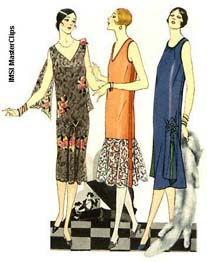 their homes into factories,
began to see long hair as a nuisance. Then in the wide-open days of the 1920s,
women’s styles became boyish and they began to wear “bobbed” hair (i.e. short).
The bobbed cut was not exactly new, it has been worn by women (and men) since
Roman times. However, it was more than a century since the bob was popular and
it became the rage for many people. (And an outrage for others.) When I was a
girl in the 1920s the big question was, “To bob or not to bob?
Some people said that a woman that bobbed her hair was a
“disgraced women” of low morals. And at least robbed her of her femininity.
their homes into factories,
began to see long hair as a nuisance. Then in the wide-open days of the 1920s,
women’s styles became boyish and they began to wear “bobbed” hair (i.e. short).
The bobbed cut was not exactly new, it has been worn by women (and men) since
Roman times. However, it was more than a century since the bob was popular and
it became the rage for many people. (And an outrage for others.) When I was a
girl in the 1920s the big question was, “To bob or not to bob?
Some people said that a woman that bobbed her hair was a
“disgraced women” of low morals. And at least robbed her of her femininity.
Around 1950 there was a trend from longer styles to shorter styles and when all the girls with long hair saw how cute the short cuts were, it didn’t take them long to call me on the phone. They’d generally said something like, “Dorothy, I want my hair cut. Can you cut it right now? I generally told them to come in later in the day and I’d work them in, which generally caused them to say, “But I’ll loose my nerve by then,” she’d say.
Suddenly, in the late 1950s
there was the poodle cut.
I’ll give you three guesses
what that was like. If you happen to have a pet poodle, put him out in the rain
for ten minutes and there you have it. If you want to know how to cut a poodle
cut, just cut it two inches long and put in a tight curl. Never mind setting it.
ten minutes and there you have it. If you want to know how to cut a poodle
cut, just cut it two inches long and put in a tight curl. Never mind setting it.
Other styles popular in those
days were the flip and the
pageboy. In both the flip and shoulder length. In a flip the then the
curls were turned up. In a pageboy you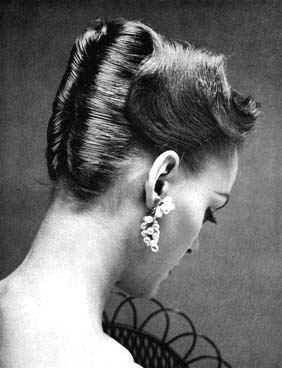 turned the curls under.
Many of the older ladies wore a French twist. The hair was longer and a stylish roll was combed and pinned up the back of her head. I sold pretty rhinestone combs to wear alongside this roll. One day I decided I would try my own hair that way. I did it and although the hair looked nice, I decided I looked like a little old woman. I quickly changed it.
In about 1955 rollers replaced pin curls as a means to curl hair. At first they were difficult to use. They consisted of a small cylinder of wire mesh around which you wrapped the hair. Later, they were available with a brush inside that held the hair while it was being wrapped. The rumor was that a beauty operator somewhere had trouble with the original ones so she placed a brush inside it to hold the hair. The owner of the shop saw her do this and started manufacturing them. Still later, plastic rollers were used to attract the hair while it was being rolled.
You probably remember in the
1950s when Dwight D. Eisenhower was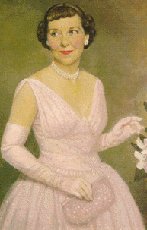 President. Well, his wife, Mamie, had very
thin hair and wore her hair in bangs. Suddenly whether she looked good or not,
everyone wanted “Mamie Bangs.” I put them on young folks, I put them on old
folks, and I put them on fat and thin folks. Everyone wanted Mamie Bangs. And
of course, if you were a Republican, you wanted them even more.
President. Well, his wife, Mamie, had very
thin hair and wore her hair in bangs. Suddenly whether she looked good or not,
everyone wanted “Mamie Bangs.” I put them on young folks, I put them on old
folks, and I put them on fat and thin folks. Everyone wanted Mamie Bangs. And
of course, if you were a Republican, you wanted them even more.
Talking about politics, I remember one time in the early 1960s when John F. Kennedy was President. Of course, every magazine had a picture of Jackie on its cover. One day a lady under the dryer picked up a magazine with a picture of Jackie Kennedy on the cover. Suddenly, she slammed the magazine on the floor and said, ‘‘I get so tired of seeing that woman.’’ She was wearing Mamie Bangs, of course. Who says women don’t make political statements with their hair.
In the late 1960s the behive was the hair
style of choice. You just combed back the hair until every strand stood straight
up. Then smooth out the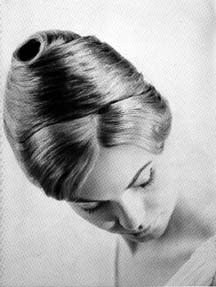 outside so it was real smooth. I never liked to give
them and thank goodness the style never lasted very long. It was almost
impossible to sleep with them. Some girls wrapped their entire head in bathroom
tissue when they went to bed, hoping it would help it stay in place. Of course
you couldn’t move while you slept. Generally, the girl got up with paper all
over the bed. One company even sold paper caps that you could wear at night. You
can understand why the style lasted for only a few years.
outside so it was real smooth. I never liked to give
them and thank goodness the style never lasted very long. It was almost
impossible to sleep with them. Some girls wrapped their entire head in bathroom
tissue when they went to bed, hoping it would help it stay in place. Of course
you couldn’t move while you slept. Generally, the girl got up with paper all
over the bed. One company even sold paper caps that you could wear at night. You
can understand why the style lasted for only a few years.
Believe it or not, combs have been in existence for more than 6,000 years when the Egyptians first made them out of fish backbones. The word is derived from the ancient Indo-European term, “gombhos” which means teeth.
In the early 1960s the Hollywood cut came into vogue -- for boys. At the time many boys wore their hair longer than girls. I cut many boys hair since they said barbers cut it too short. At this time the state law only allowed beauty operators to work on boys 12 or younger. In the 1960 the laws were changed and beauty operators can now work on the hair of all men. Nowadays, men even have perms put in their hair. Gads!
Between 1949 and 1969 while I was in my shop the most popular hair styles were:
pompadour 1949
shingles 1952
bangs 1953
flip 1953
French twist 1953
duck tail 1953
poodle cut 1954
shag 1954
butch cut 1955
page boy 1955
beehive 1959
Cleopatra look 1959
artichoke 1960
Buster Brown 1961
flip 1963
poodle cut 1964
artichoke 1964
bubble 1965
Hairstyles for the past 100 years can be found at the website: www.hairarchives.com/private/archives.htm .
When the poodle cut and the ponytail were competing hairstyles, some girls would joke that they were deciding to cut their hair like a dog or a horse.
Of the hundreds of women that came into my shop all were friendly, polite, and of course, paid their bills. Well, I shouldn’t say all. I guess no matter what business you’re in; there are always a few rotten apples in the barrel. One day this lady, whom I had never seen before, came into my shop and wanted a perm. The best perm in the house, she said. That was nice. I shampooed, cut, and was half way through wrapping her hair, when she said. “Oh, by the way I can’t pay you today.” Yeah. I kept wrapping and said that was fine but my policy was to collect a third of the total on the day the work was done. She said O.K. When she left, I had the feeling I would never see the other two-thirds. She lived in town all summer and came in for a shampoo and set every week. Several times I asked her to pay something towards her bill, she would always say she was “short.” She did buy small items I had for sale in the shop and so, thinking she had no plans of paying her bill, I made a point to unload as many of these items on her every time she came in. I never did get the other two-thirds, but she sure bought a lot of shampoo. And I sure had a lot of fun selling them to her too.
Another lady I would just as well forget came into my shop one day for a permanent. She had a bad cold and what seemed to be a case of the flu. I suggested she might like to get her perm at a later date, since perms often don’t “take” well when a person is sick. Well, she asked if that was my usual way of getting out of bad permanents, but insisted I go ahead with the perm. I did, against my better judgment. A couple of weeks later she came in again, still hoarse and not feeling well. She also told me I had given her a terrible perm and wanted me to do it over. I told her to wait a couple more weeks and then come back. I would then look at her hair and see if I should give her another one. There have been times when the perm just didn’t take well, for whatever reason, and I would redo it. Well, she didn’t come back. Then, six months later, she called and said I could now give her the perm I owed her. I asked her if she had gotten another perm in the meantime. “Oh, no,” she said, “I just put up with it.” I told her that I would be more than happy to give her a perm but she would have to pay for it. Was she angry. She called me every name in the book. And a few I hadn’t heard. She never came into my shop again, and she was the only person I’m glad didn’t. She was also the only customer I ever hung up on.
Another lady whom I did not know came into my shop one day, and as I started to shampoo her hair, she suddenly said, “I rarely get shampoos in beauty shops because they just don’t rub hard enough.” My only comment is that she never said that again.
One day an old friend and regular customer, Mildred, came into my shop one day for a shampoo and set. While I was shampooing her, she told me her young daughter, Marilyn, had been out of school with the flu but had returned that afternoon. She said she told Marilyn to be sure to wear a scarf and coat when she went out for recess. Well, my shop was just across the street from the school and while I shampooed I often looked out the window. Just then I looked up and there was Marilyn and her little friends playing up and down the sidewalk in front of the school. And guess what? Little Marilyn was not wearing her scarf as her mother requested. In fact she wasn’t even wearing her coat! Suddenly, Marilyn stopped and looked across the street. Seeing her mother’s car in front of my house, she ran to where her coat and scarf were lying and put them on and continued playing. So Mildred, if you read this, now you know.
Several salesmen called on my shop regularly. Most of them were very helpful and not only gave me advice about new products, but kept me informed about new hairstyles. In fact one salesman had been an operator for many years and his specialty was cutting hair. Well, the new tailored cut had just become stylish, and if I weren’t busy when he came, he would cut my hair. One time, however, I was in the process of giving a perm when he came and I told him I didn’t have the time that day. Sure you can, he said, just continue working. So as I gave the lady her perm, he cut my hair. I wonder if that is a first? The lady in the chair sure thought so.
One thing I learned from the salesmen was all the goings on in the other beauty shops in the area. I learned the ones that didn’t’ pay their bills and the ones that used cheap solutions. Then I started wondering what they said about me.
One dear lady and a regular customer, who imbibed a bit too much (I mean her breath would knock you over), was always doing thoughtful things for me. Many times she brought vegetables from her garden and once she brought a jar of canned pickles. They were very good, and I told her so. So, the next time she came in she had a large container of washed and stemmed cukes all ready to be made into pickles. On the top of them lay the recipe.
Anyway, one day when I put her under the dryer, another lady comes in. On the few occasions when these two ladies were in the shop together I could nearly feel the icicles in the room. Later, when the “pickle” lady left, the other lady told me that if I was going to continue working on the pickle lady, I could forget about having her as a customer. I held my tongue but it was hard. After that, however, I scheduled those ladies on different days.
One day a lady, who had never been to my shop before, brought her daughter to get a perm. I started to work on the daughter while the mother waited in a chair. Everything was going nicely. After I put the daughter under the dryer, an elderly lady came in for a shampoo and set. But as I started to shampoo her, the first lady got up and decided to help. This would seem strange enough but once she stood up there was another problem. The lady reeked. (I don’t think she had bathed in weeks!) She said she just loved to help with old people. She even tried to help me shampoo her hair. Finally, I couldn’t stand it any longer, and told her I would appreciate it if she would sit down. That didn’t stop her. Finally, I gave her the lame excuse that state law didn’t allow her to help. I told her I would get arrested since I was expecting the state inspector to come at any time. Well, she bought that story and finally sat down. I don’t know who was more thankful, the old woman or myself, but when she left I took a can of room freshener and gave that room a going over. The lady under the dryer laughed and asked me if I did that when all my customers left.
My customers told me they liked the “decent” magazines, like National Geographic, which I kept in my shop. This way they didn’t have to bring their own magazines when I put them under the hair drier. “You don’t have those sleazy things like they have in some shops,” one woman told me. Then one day a woman came in the shop and brought with her a sleazy tabloid magazine, which she read, under the drier. When she left she forgot to take it with her. And for the next six months that magazine was read within an inch of its life.
Nowadays, when I go into a beauty shop, I am aghast at the high prices. ‘Twas not always so. When I first started in my shop in 1949, I charged $.75 for a hair cut. A shampoo and set was $1 and for an extra quarter you got a color rinse. And you could get a simple neck trim for the grand total of ten cents. A tint was $2.50. As time went on the price of solutions and so on increased and naturally I had to raise my prices. When I left my shop in 1969, I was charging $1.75 for a hair cut, $2.50 for a shampoo, $3.50 for color rinse, and $5 for a hair tint. Once when I raised my prices it just happened I also purchased a new car. I really got kidded about that one.
|
|
1949 prices |
1969 prices |
1996 prices |
|
hair cut |
$75 |
$1.75 |
$6 |
|
Shampoo |
$1 |
$2 |
$7.50 |
|
neck trim |
$.10 |
$50 |
$1.50 |
|
color rinse |
$1.25 |
$3.50 |
$6 |
|
hair tint |
$2.50 |
$4 |
$8 |
|
basic perm |
$8 |
$15 |
$30 |
One benefit of being a beautician is that you can always get a job as an airplane riveter. During the Second World War airplane factories would hire beauticians to rivet in places you couldn’t see. It was a piece of cake for the beautician -- just like putting in pin curlers.
Another big word I learned in beauty school was sebaceous, as in a sebaceous cyst. The common name for this cyst is a wenn. They are not serious and can be taken off quite simply by a doctor. Anyway, one lady had a very large one on her noggin but didn’t want it removed. Time passed and the cyst was getting softer and softer. I was really afraid it might break when I shampooed her so one day I told her it wouldn’t be any problem if I just got out my razor and sliced it off. I heard later the next day she was at the doctor’s office getting it removed.
Tipping was not common at that time in small Iowa towns. However, one day I had a lady from California who was visiting her family near Rolfe. She had me do her hair and when she asked the price she was astounded. She not only gave me the amount she paid in California but a tip as well. She then proceeded to give the other ladies in my shop a lecture about making “that poor girl” work so hard and not paying her enough.
One customer of mine always had a great sense of humor. She always wore a hearing aid, glasses and jewelry when she came in. One day she was a bit late and before getting in the shampoo chair, she hurriedly started removing her hearing aid, glasses and jewelry. At about the time she had everything removed, she stopped and laughed and said, “Well, it’s a darn good thing I don’t have a wooden leg”.
One question husbands always ask me is, so what do ladies talk about in the beauty shop? One word. Hair.
Hmmmmmm
At one time I thought it would be nice to put in a massage or exercising machine in my shop. They were popular in the 1950s and I thought it might bring in some extra income. It didn’t. Anyway, I put the “machine” in a small room in my house and the ladies would go in and lie on it for a while as the machine vibrated and massaged their hips and shoulders. One day a lady who had been using it for about a month called me and told me she was pregnant. Hmmmmmmmm.
Waiting for the Wives in the Beauty Shop
In the ‘50s many women did not drive the family car and so when they came to the beauty shop their husbands brought them. Some of the men would sit in the car the whole time, and some went downtown and came back later to pick up their wife. Most of them would come in the shop and ask how long it was going to be until she was finished. I always invited them in to wait. For some reason many of them felt they had to entertain me with some type of humor and wit. Others just had a nice visit. Those I enjoyed.
Once a man came back from downtown and just sat in his car waiting until his wife was finished. His wife, however, had walked downtown earlier to meet him. I didn’t know of their plans, and I didn’t know the man since they were from out of town. At first I didn’t think anything about this man sitting in the car since my house was directly across the street from the school and there were always people waiting for their kids in front of my house. Finally, he came to the door and asked if his wife was about ready. When I told him what had happened, he wasn’t too happy. And I doubt if his wife was either.
The Last Haircut
When I first started in my shop, Mrs. Bruce was one of my favorite customers. She always encouraged me in those early days, which was a big help. I knew she was ill with a bad heart, but I was shocked when the funeral director called me one day and asked if I would fix her hair. Gulp. I had never done anything like that before. As I hesitated, he said one of her last wishes was that she wanted me to do her hair after she died. “She knows how I like it,” she had said.
I’ll never forget the feeling I had as I walked into that room and saw my good friend lying there. A few minutes later after I had started working, it didn’t bother me and I just thought about all the nice things she said to me on those first days. After that, I fixed the hair of many of my customers after they died.
One day the funeral director, Lowell, asked me to fix the hair of a woman, and when I approached the table where the lady lie, Lowell said, “Here, that’s too high for you, let me lower it a bit.” He had attached the steel preparation table on top of the base of an old barber’s chair so he could raise and lower it, thus making his work easier. So, I started doing this woman’s hair when all of a sudden the hydraulic gives away and the table collapses with a bang. Lowell stood there laughing and said, “Boy, did you jump.” I told him I almost ran out the door.
Once I set a head of hair at the funeral home around noon and then returned to my shop where my first appointment was waiting. I generally didn’t advertise the fact that I worked on ladies at the funeral home, but this time I accidentally let it slip that I had just combed out this particular lady’s hair. The funniest expression came over her face. Later a friend of hers told me the lady said she had strangest feeling knowing my previous customer had been a cadaver.
The hardest job I ever had in the funeral home was with a lady who was bald except for a fringe around the edge. She wore a wig, but hadn’t actually put it on for a ling time and it was very dirty. I cleaned it, but when I put it on her it not only didn’t fit, but she looked “brassy.” After stretching it out and combing white hair into the wig, however, she looked quite nice. Several of her family said they liked the way she looked.
One of my favorite ladies, Mabel, used a dark blue rinse on her hair, which was the thing to do in the ‘50s, and ‘60s. Most all ladies that had white hair used some shade of blue rinse. White hair had a tendency to turn yellow, especially when the person spent a lot of time in the sun. Anyway, Mabel’s husband unexpectedly became ill and died. The day before the funeral she came in for a hair set. So I put in the rinse, but for some reason it did not take. I used a little stronger rinse, and it still came out too light, not the usual dark shade that she preferred. There was nothing I could do, so I just left it. I did not mention it to her since she had other things on her mind. In the next few months every time I did her hair the rinse came out light blue instead of the dark blue. Then, about six months later, it gradually it started getting darker until it was back to her usual color. I asked if she had noticed it and she said, “Oh, I just thought you wanted it colored that way.” I told her I didn’t and thought it was due to the shock of her husband’s death. And some people try to tell me that health has no effect on hair.
She was such a dear lady and said I could do anything with her hair. She generally wore her hair short but her hair had grown out and she was in need of a permanent. She kept saying sometime soon. Well, since it was now long and she never minded what style I put in her hair, I decided to put in a French roll. She looked great and was so pleased that she drove to her daughters just to show it to her. She liked it so much she wanted it every time. “Well, you sure cheated yourself out of a perm,” she joked to me.
I once gave a white-haired lady a perm who had been my customer for all the years I worked in the shop. She had lovely, silky hair, which took a beautiful perm. But on this particular time, when I took the rods out, I nearly gasped. Every end was amber. I cut them off and used a solution to take out the yellow left in her hair. I asked if she had used anything on her hair during the prior week. She had not for she always came to me for her hair care. I then asked her if she had a physical examination lately. She told me, no, that she was healthy. I asked her if she had a kidney infection. No, no, no, she said. Please go and find out, I said. A few weeks later she came in and told me I had been right. She did have a kidney infection. Yes, it will turn your hair yellow; a very dark yellow.
One of my favorite customers started calling me on occasion to say she just wasn’t in the mood to have her hair fixed that day. After several of these calls I began to wonder why she did this. It even became a bit annoying, for she never gave a real reason, but she just “guessed she wouldn’t have her hair done that day.” Then one day the telephone rang and I was told that this dear lady had died suddenly. It seems that she had a very bad heart, which very few people knew about. I was always sorry that she had not confided in me. At least I would have been more understanding.
I had never seen green hair before, but one day a businessman from downtown stopped by my shop and asked what I thought was a stupid question. “Do you have any green hair coloring?” he asked. He said it wasn’t really a stupid question since Rolfe was celebrating its 100th birthday and some of the men in town were growing beards for the occasion. I told him in case he didn’t know most beards weren’t green. But, he explained they were going to march in the St. Patrick’s Day parade in Emmetsburg that year and they wanted green beards. It was my understanding they made a colorful spectacle in the parade. That was my only experience with green hair. It was enough.
“You did say a purple rinse didn’t you?” I asked. Yes, she said. She told me her daughter was getting married and she bought a purple dress for the occasion. The dress was so pretty that, naturally, she needed purple hair to match it. So, I ordered purple rinse from a hair products company. With the green dye I ordered the year before, I must have had quite a reputation. This lady was serious. She wanted her hair to match her dress. She bought the dress in and I matched it. She seemed so happy and I wondered why.
I am sure some of my customers were among the best cooks in the land. Dora made the most delicious chess pie. She gave me the recipe, but I never could make it as good as hers. The rolls that Mrs P. and Marcella brought were absolutely out of this world. And the cookies, and Norwegian, Swedish and Danish goodies that all my Scandinavian customers made helped me gain some unwanted pounds. But who cared. They were the most delectable goodies I had ever tasted. My kids would look at these goodies and immediately knew who made them. They were soooooooooo good. Some of my thoughtful customers brought me recipes that took very little time to prepare. They knew my cooking time was limited. All this I appreciated.
I quickly learned how to prepare oven meals of casseroles, roasts, and baked potatoes. This was one advantage of having my shop in the house since they could be cooking while I worked. If I worked late, my children would fix the meal. This would generally consist of chili, goulash or chow mein. If they had to go to choir practice, or some activity at school, they would eat their own suppers and then put my dinner in the oven and it would be hot when I finally ate my meal.
I know the rumor. It’s just one big gossip session in the beauty shop. Well, I’ll tell you right now what the ladies gossip about. It’s hair. But, there have been those occasions…
One morning a lady came in and told me that a certain man in town had just died. I knew the man had been ill, but hadn’t realized it was that serious. Anyway, a little later after the lady left the telephone rang and it was the same lady. She seemed a bit frantic and told me not to repeat the story that Mr. so-and-so had died. When I asked her why, she told me she had just seen him in the bank. Luckily, I hadn’t passed the bad news on to anyone else.
One lady who always enjoyed a juicy tidbit of gossip and a good story (some of which I didn’t appreciate) once remarked that she bet I heard a lot of ‘good stuff in my shop. “Real good stuff,” I said and didn’t say any more. If she only knew I never repeated gossip, and tried to discourage degrading remarks that were made on occasion.
As I snipped, shampooed and set hair for those twenty years, I heard more than one story of heartache and sorrow. Once after a lady left my shop and returned home, she called and said, for heaven’s sake don’t tell anyone what I told you. And I won’t tell you.
Another lady told me all about her daughter’s marital troubles. Later, she came in with a lovely set of doilies she had crocheted and told me they were for me for listening to her when she needed someone.
We’ve all heard them -- and not just from old wives, but from young ones as well. Well, hair has its own list of superstitions, some true, some false.
“Cutting your hair will make it grow faster,” one tale goes. False, it won’t affect it in the slightest. The two things that affect the growth of your hair the most are heredity and your health. The average person has 150,000 of the little fellas and they grow from one half inch to one inch per month. Keeping the split ends cut off will help hair grow. Hair has a tendency to split and break apart when it is longer. This is why is seems not to grow.
“Hair continues to grow after death.” False again. Once the blood stops, all body processes stop, including hair and nail growth.” The body dehydrates sometimes makes the hair appear longer.
“Eat your carrots and you’ll have curly hair.” Carrots do have a lot of Vitamin A, but insofar as curly hair, no way. The best way to get curly hair unless you are blessed with it naturally is to go to your beauty operator and get a permanent wave. “Imbibing will ruin a good permanent.” Moderate indulgence will not ruin a permanent, but excessive drinking will ruin one’s health, which is a prerequisite for healthy hair.
“She’s a redhead, she’s got a temper.” The English started this rumor in response to the redheaded Danish invaders.
“I was so scared my hair stood on end.” Extreme fear can cause the skin near the surface of the scalp to contract causing the hair to stand up more. On our arms we call this phenomenon, “goose pimples.”
“Gentlemen prefer blonds.” You’d have to ask a gentlemen about that.
Epilogue
And so as I finish combing out my friend’s hair and begin to untie her cape, my mind drifts back over the years… . “Looks better now than when I came in,” she laughed. That was her standard joke. She was my very last customer and I can’t help but shed a tear. I realize that a major part of my life has just come to an end. Maybe the most trying part, and possibly the most exciting.
“What will you do with all your time now, Dorothy?” my friend asks. She knew, of course, that I was getting remarried and was moving to Ayrshire to begin a “new life.” “I guess I’ll just sit back, kick up my heels and relax,” I joked.
For the past twenty years, I had lived a full and interesting life raising three children and working in my shop. I will never forget the many wonderful ladies that walked through my shop door, and how good they were to me. And that delightful town of Rolfe will always have a special place in my heart. My home.
And as the lady walked out the door I thought of many things. But the thing that lingered in my mind was that no matter what problems we face in our lives, they can always be overcome -- and generally overcoming them is the most rewarding.
The End